ACADEMICS IN
MIDDLE SCHOOL
At Open Window, middle school academics are a launchpad for lifelong curiosity and confidence.
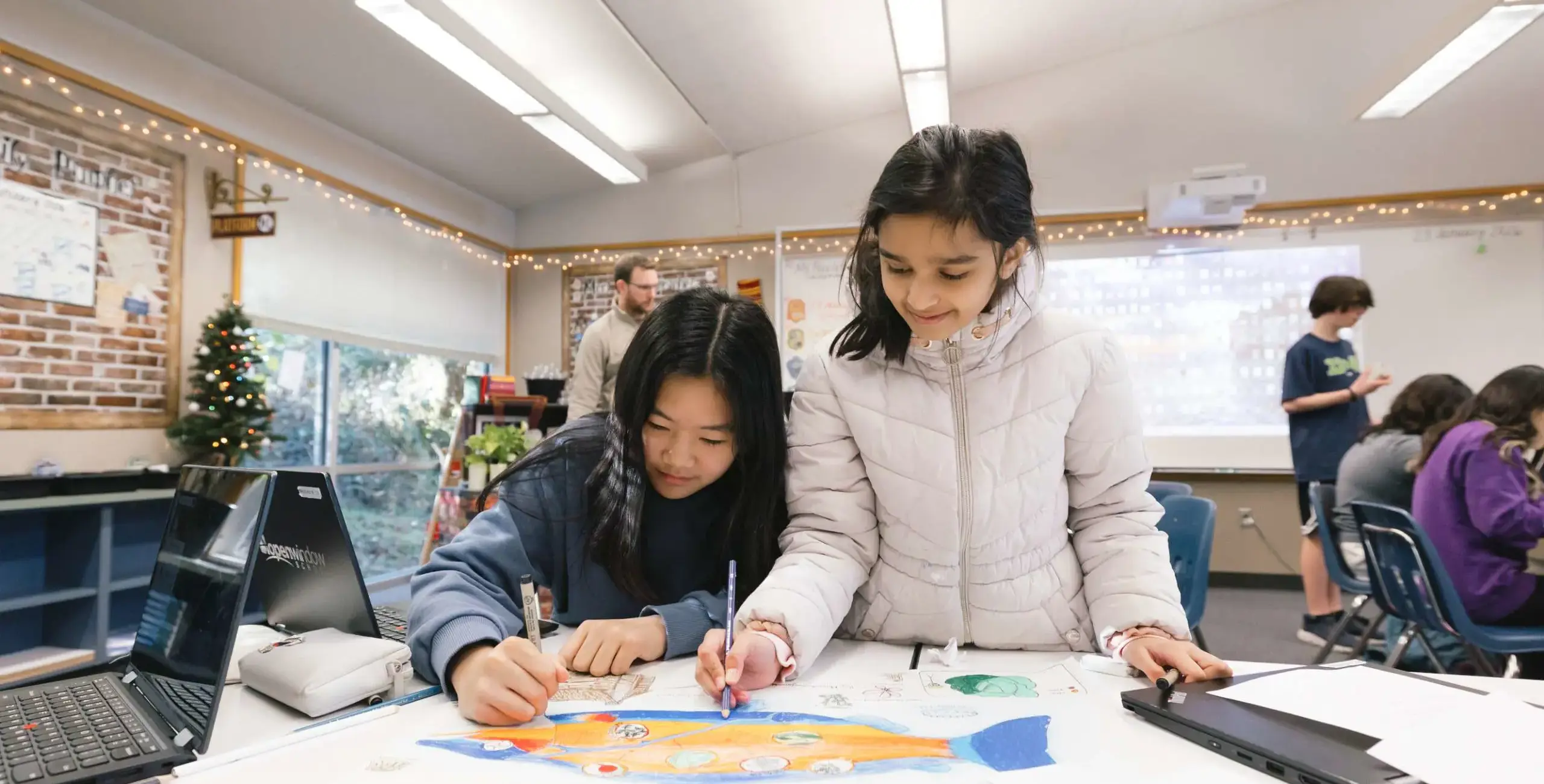
Designed for gifted learners, our program is intellectually rigorous, emotionally responsive, and intentionally interdisciplinary. We challenge students to ask big questions, make meaningful connections, and discover who they are as thinkers, collaborators, and creators.
Across all subjects, Open Window teachers design learning experiences that are interdisciplinary and meaningful, and engaging for the gifted mind. Students might apply math in science labs, explore ethical dilemmas through literature, or use technology to deepen historical research.
| GRADE 5 | GRADE 6 | GRADE 7 | GRADE 8 |
GRADE 5 |
Language Arts |
| Students build the foundations of close reading through fiction and poetry while writing their own short fiction and poetry. They begin analytical writing and study how structure and language work in both their writing and professional texts. A signature poetry project culminates in community reading and a class book of student work. |
| Math & Science |
Students in grades 5 and 6 learn science topics in tandem on an “A” year, “B” year rotation, which gives them time to go deep and revisit ideas over two years. Work is hands-on and exploratory, and students learn as collaborative scientists in the lab. In 5th grade, this may look like students supporting one another as they design and build electro-magnetic motors, exploring how the shape of a coil affects motor speed during an “A” year. It may also look like students researching the effects of earthquakes as they learn about seismology, then designing structures they can test with simulated movements to understand how waves affect infrastructure |
| Social Studies |
| Students study the birth and growth of ancient civilizations, from Mesopotamia and Egypt to Greece and Rome, to understand how societies form, govern, and innovate. Alongside content, they practice core historian skills like analyzing primary sources, comparing cultural perspectives, and constructing evidence-based explanations. Projects include individual work such as the Neolithic Comic and the Mohenjodaro Brochure, and collaborative work such as the Hominid Poster and an Ancient Chinese Philosophy Debate. |
Spanish |
| Students share about their families, listening and formulating questions as they explore who they are and how they belong, sparking curiosity for deeper learning in the language. |
Visual and Performing Arts |
Visual Art Music Drama |
| Technology |
5th through 8th grade core skills courses allow students to experience an interactive and collaborative introduction to the field of computer science, framed within the broader pursuit of solving problems.
Web Development The Design Process Physical Computing Data and Society Language, Culture, & Computing Artificial Intelligence and Machine Learning |
| PE/Health |
Using an alternating A/B-year sequence, we introduce a wide range of team sports in PE class. Units of focus include team handball, volleyball, basketball, soccer, ultimate frisbee, rugby, baseball/softball/cricket, lacrosse, and pickleball. In each unit, students learn fundamental skills through games and drills, then apply them in structured play that teaches rules, strategies, and sportsmanship. Each unit blends fitness with purposeful play so students can move their bodies, build community, and experience success at different challenge levels. In Health, we teach with a skills-based approach where students build communication and decision-making skills and apply content knowledge to everyday contexts. The curriculum highlights how human body systems support movement and wellness, and how nutrition fuels growth and daily life. Students also learn practical ways to care for their bodies as they continue to develop. Our Health, Sexuality, & Relationships (HSR) unit explores puberty and the development of the human body, linking the endocrine and reproductive systems to the physical and emotional changes students can expect to experience. |
| Social-Emotional Learning in Middle School: Skills & Mindsets |
| 5th and 6th graders engage in specific activity-based lessons curated from the Institute for Social Emotional Learning (IFSEL) curriculum. Students intentionally develop respect and trust (through listening, empathy, problem-solving, and perspective-taking), build self- and social-awareness (by exploring and sharing who they are, what matters to them, and learning about their peers), practice focus and centering (through mindfulness, identifying sources of stress, and applying tools to improve the moment), and play with purpose (by engaging in play, breathing, communicating, and having fun). |
Media Literacy |
| Students discover the “Five Freedoms” protected by the First Amendment and why a free press matters. They explore how freedom of expression supports fairness, truth, and active participation in our communities. |
| Financial Literacy at OWS |
Students learn to tell the difference between what they want and what they need. Through games and real-world examples, they practice making smart choices, understanding value, and considering consequences. |
Executive Function & Study Skills Program |
Students establish routines that support academic success by organizing materials, using planners and checklists, setting realistic goals, breaking assignments into manageable steps, and developing focus and persistence through structured practice. |
GRADE 6 |
Language Arts |
| Students explore how authors create meaning through elements such as character, conflict, and setting. They read novels in book-club groups that prioritize the joy of reading while practicing what strong readers do to interpret a text. Students show understanding through projects such as zines, poetry, and setting dioramas, alongside analytical writing, building both confidence and skill. |
| Math & Science |
Students in grades 5 and 6 learn science topics in tandem on an “A” year, “B” year rotation, which gives them time to go deep and revisit ideas over two years. Work is hands-on and exploratory, and students learn as collaborative scientists in the lab. In 5th grade, this may look like students supporting one another as they design and build electro-magnetic motors, exploring how the shape of a coil affects motor speed during an “A” year. It may also look like students researching the effects of earthquakes as they learn about seismology, then designing structures they can test with simulated movements to understand how waves affect infrastructure |
| Social Studies |
| Students trace American history from time immemorial through the early 1800s, examining Indigenous societies, the founding of America, and the development of civic and geographic structures. With perspective as a guiding theme, students evaluate primary sources and craft evidence-based arguments through inquiries such as “Who is really to blame for the Boston Massacre?” and “What happened to the Lost Colony of Roanoke?” Students strengthen argumentative writing, learn to recognize bias, and synthesize multiple accounts as they examine how historical narratives are constructed from artifacts and uncertainty. |
Spanish |
| Students engage in deeper understanding of grammar and structure of the language through conversations and cultural studies in the target language, reinforcing listening, interpretive, and speaking skills. |
Visual and Performing Arts |
Visual Art |
| Technology |
5th through 8th grade core skills courses allow students to experience an interactive and collaborative introduction to the field of computer science, framed within the broader pursuit of solving problems. Web Development The Design Process |
| PE/Health |
Using an alternating A/B-year sequence, we introduce a wide range of team sports in PE class. Units of focus include team handball, volleyball, basketball, soccer, ultimate frisbee, rugby, baseball/softball/cricket, lacrosse, and pickleball. In each unit, students learn fundamental skills through games and drills, then apply them in structured play that teaches rules, strategies, and sportsmanship. Each unit blends fitness with purposeful play so students can move their bodies, build community, and experience success at different challenge levels. In Health, we teach with a skills-based approach where students build communication and decision-making skills and apply content knowledge to everyday contexts. The curriculum highlights how human body systems support movement and wellness, and how nutrition fuels growth and daily life. Students also learn practical ways to care for their bodies as they continue to develop. Our Health, Sexuality, & Relationships (HSR) unit explores puberty and the development of the human body, linking the endocrine and reproductive systems to the physical and emotional changes students can expect to experience. |
| Social-Emotional Learning in Middle School: Skills & Mindsets |
| 5th and 6th graders engage in specific activity-based lessons curated from the Institute for Social Emotional Learning (IFSEL) curriculum. Students intentionally develop respect and trust (through listening, empathy, problem-solving, and perspective-taking), build self- and social-awareness (by exploring and sharing who they are, what matters to them, and learning about their peers), practice focus and centering (through mindfulness, identifying sources of stress, and applying tools to improve the moment), and play with purpose (by engaging in play, breathing, communicating, and having fun). |
Media Literacy |
Students learn what quality journalism looks like, accuracy, fairness, and transparency, and practice telling the difference between news, opinion, and entertainment. |
| Financial Literacy at OWS |
| Students explore what it means to think like an entrepreneur. They learn how creativity, problem-solving, and planning come together to build a business idea, and how teamwork and innovation can turn ideas into action. |
Executive Function & Study Skills Program (Grades 5–8) |
| Students apply foundational strategies to meet increased middle school demands by planning ahead across classes, practicing scheduling and time management, exploring learning styles and study preferences, managing attention, motivation, and digital distractions, and building confidence through accountability and reflection. |
GRADE 7 |
Language Arts |
| Students focus on author’s purpose discovering and making hypotheses on why a writer wrote a particular piece at a particular time. Students read a wide range of fiction and nonfiction and analyze texts through read-aloud techniques, intensive questioning, annotation, and roundtable discussion. Persuasive writing strengthens their ability to make claims supported by evidence, informing their own composition. |
| Math & Science |
Students study air space science, earth science and chemistry as young scientists. Students work in interdependent teams to design space missions by researching current technology and proposing improvements. Working directly with aerospace engineers, they learn physics principles such as conservation of momentum, nuclear reactions, and chemical reactions. |
| Social Studies |
| Students use diverse perspectives and complex global issues as entry points for research, writing, debate, and creative problem-solving. They participate in a Model United Nations simulation, serving as international delegates who research global health inequities and negotiate resolutions, including equitable access to healthcare for women in Latin America and the Caribbean. Students also debate secularism in India, analyzing how constitutional principles shape societal cohesion by evaluating the impact of religion on community values, political representation, and social dynamics. |
Spanish |
| Students learn to understand control of pace, intonation, inflection and build fluency as they prepare presentations, engage in interviews and hold discussions in the target language such as exploring the rights of farm workers developed from the work of Cesar Chavez and Dolores Huerta. |
Visual and Performing Arts |
Visual Art Music Drama |
| Technology |
5th through 8th grade core skills courses allow students to experience an interactive and collaborative introduction to the field of computer science, framed within the broader pursuit of solving problems.
Web Development The Design Process Physical Computing Data and Society Language, Culture, & Computing Artificial Intelligence and Machine Learning Grades 7–8 (Electives) Previous and current electives topics have included:
|
| PE/Health |
Using the same A/B-year sequence, students return to these sports as 7th and 8th graders with greater fluency and tactical awareness. Instruction balances ongoing skill work with collaborative and competitive play, preparing students to continue these sports beyond class on our OWS teams or with local clubs. In Health, we extend our skills-based approach, giving students opportunities to practice clear communication and informed decision-making related to a variety of health topics. In 7th grade, our HSR unit focuses on consent, boundaries, and healthy relationships. In 8th grade, the HSR unit revisits reproductive systems and introduces contraception and sexually transmitted infections, with an emphasis on safety, respect, and accessing reliable information. As graduates, students leave the program with a clear understanding of how physical, mental, and emotional health are connected and with the mindset and skills for lifelong wellness. |
| Social-Emotional Learning in Middle School: Skills & Mindsets |
Core competencies deepen as students begin to understand their unique learning profiles. Students create individual assessment journals exploring areas such as giftedness and creativity, observation and perceptiveness, leadership and charisma, focus of control, task valuation, communication, and resilience. After reviewing assessments, students craft a strength-based goal that considers both areas of growth and potential obstacles. |
Media Literacy |
Students learn how to verify information, recognize misinformation, and evaluate claims. They practice asking questions and checking evidence as core habits of smart media consumers. |
| Financial Literacy at OWS |
| Students dive into budgeting basics, earning, saving, and spending wisely. They also learn to plan for surprises, building resilience and flexibility when life doesn’t go exactly as expected. |
Executive Function & Study Skills Program |
Students refine executive function skills as academic complexity increases by strengthening note-taking and active study techniques, learning test-preparation and review strategies, planning long-term projects, using self-assessment to identify strengths and areas for growth, and applying a growth mindset to academic challenges. |
GRADE 8 |
Language Arts |
| Students uncover how to skillfully express their voice through writing across the year. They strengthen academic writing through evidentiary analysis, then extend into creative voice through creative fiction and nonfiction as they close out their middle school language arts experience. |
| Math & Science |
Our 8th grade Biology is a high school level course. Students develop questions that investigate interrelationships in biology, study evolution, genetics and explore solutions. They participate in real science work through a partnership with scientific researchers in Tirimbina, Costa Rica, including bat research and related topics that deepen their understanding of ecology, community, and global biology. |
| Social Studies |
| Students return to American history with a focus on government, civics, and reform between 1800 and 1920, explored through the lens of Washington State’s growth and development. They examine systems of power, civic responsibility, and the ongoing effort to expand democracy through hands-on projects, including designing historical landmark signposts that highlight local stories of the land and drafting and debating original bills in a mock Washington State legislature. Research-based writing and civic simulations help students connect historical reasoning to contemporary issues as they prepare to engage thoughtfully with their communities. |
Spanish |
| Students showcase oral proficiency and immediate response in the target language as they interview a native speaker about their immigration journey and connect with host family members in Costa Rica. |
Visual and Performing Arts |
Visual Art Music Drama |
| Technology |
5th through 8th grade core skills courses allow students to experience an interactive and collaborative introduction to the field of computer science, framed within the broader pursuit of solving problems.
Web Development The Design Process Physical Computing Data and Society Language, Culture, & Computing Artificial Intelligence and Machine Learning Grades 7–8 (Electives) Previous and current electives topics have included:
|
| PE/Health |
Using the same A/B-year sequence, students return to these sports as 7th and 8th graders with greater fluency and tactical awareness. Instruction balances ongoing skill work with collaborative and competitive play, preparing students to continue these sports beyond class on our OWS teams or with local clubs. In Health, we extend our skills-based approach, giving students opportunities to practice clear communication and informed decision-making related to a variety of health topics. In 7th grade, our HSR unit focuses on consent, boundaries, and healthy relationships. In 8th grade, the HSR unit revisits reproductive systems and introduces contraception and sexually transmitted infections, with an emphasis on safety, respect, and accessing reliable information. As graduates, students leave the program with a clear understanding of how physical, mental, and emotional health are connected and with the mindset and skills for lifelong wellness. |
| Social-Emotional Learning in Middle School: Skills & Mindsets |
Students expand their understanding of neurodiversity, neurodivergence, and their own giftedness. Through activities and journaling, students learn to advocate for themselves within their learning environments, personally, socially, and academically. |
Media Literacy |
Students become responsible digital citizens by seeking out trustworthy sources and creating credible, ethical content of their own. They explore how their voices can make a positive impact in the world. |
| Financial Literacy |
Students take a closer look at how money moves in the world, from personal banking to larger economic systems. They explore how banks, credit, and interest work, gaining insight into managing their own financial future. |
Executive Function & Study Skills Program |
Students apply skills with increasing independence by integrating organizational systems across subjects, practicing self-advocacy and communication with teachers, managing multiple deadlines and complex schedules, developing resilience and problem-solving strategies, and taking ownership of their learning to prepare for high school success.
|